One Guess, Many Targets: The Design of Multi-Board Wordle
One guess can light up dozens of grids, but each board reads it differently. Multi-board Wordle turns shared clues into a puzzle of attention, information and guess economy
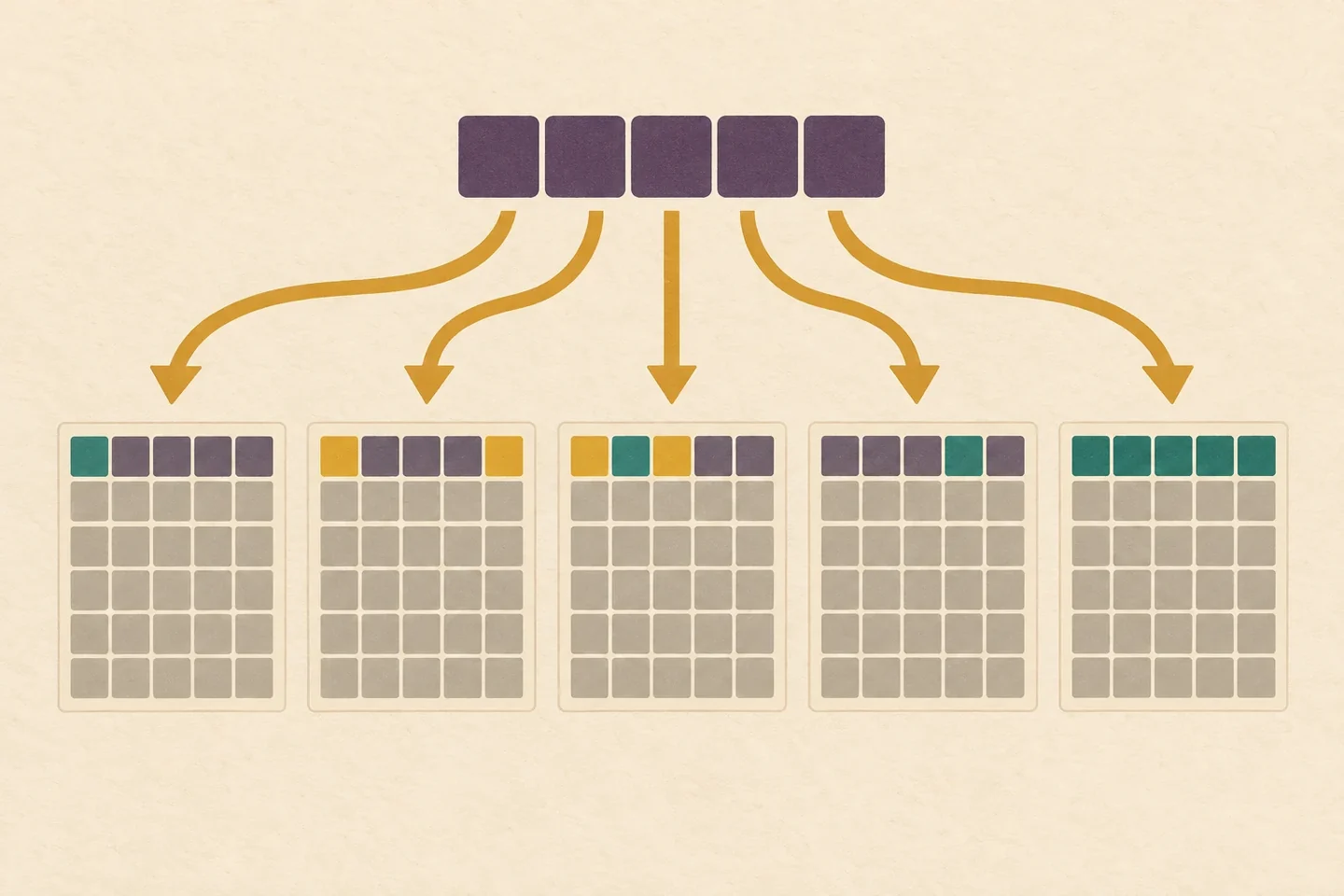
One guess lands on every board, but it never means the same thing twice
One input, several answers
The defining move is simple: type one word and send it to several hidden targets at once. Each board returns its own pattern of correct positions, misplaced letters and misses. The same guess can therefore help one answer, narrow another and tell you nothing useful about a third
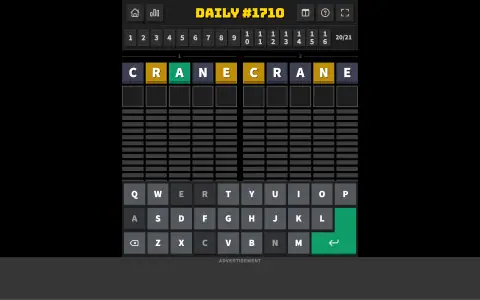
Imagine two boards with the answers CRANE and SLATE. Guess CRATE and the first board marks C, R, A and E in the right places, while T is absent. On the second, C and R are absent, while A, T and E are in the right places. One word has produced two very different readings
That contrast is the heart of the design. A gray T on the CRANE board does not rule out T on the SLATE board. Even with just two boards, the player is switching between separate little deduction problems while making a single shared move
One guess, separate clues
Read each result in place: a letter can be settled on one board and still be unknown on the next
More boards, more places for a clue to matter
The board count changes how widely a guess can pay off. Dordle puts two targets behind each word; its daily puzzle sits alongside as many extra games as you like. Quordle asks for four five-letter words in nine shared tries. Octordle sends every guess to eight boards. Those are different scales of the same central idea, not separate word puzzles bundled together
At sixteen targets, Sedecordle gives 21 guesses for all the words. Duotrigordle spreads guesses across 32 boards, with 37 tries in its standard puzzle and a Perfect Challenge that asks for all 32 words in exactly 32 guesses. The increasing field of feedback can make a guess productive on several boards at once, but it also means more clues to sort and more candidate words to keep apart
Five ways to spread one guess
-
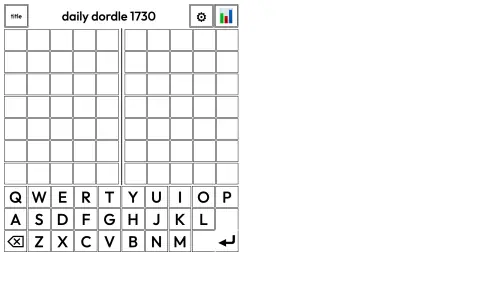
Dordle
Two Wordle boards at once: every guess counts on both words, with a new Dordle each day and as many extra games as you like
-
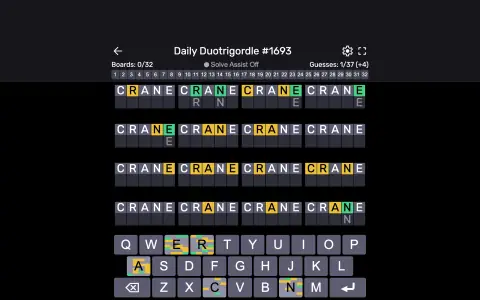
Duotrigordle
Thirty-two boards and 37 guesses, with a new game every day, a practice mode, daily variants and a Perfect Challenge
-
Octordle
Eight Wordle boards at once, with a new puzzle every day on the Merriam-Webster website
-
Quordle
Four five-letter words at once with nine tries for all four, a new puzzle every day on the Merriam-Webster website
-
Sedecordle
Sixteen boards and 21 guesses, with a daily puzzle, unlimited free ones and modes such as Sedec-order and Variations
The board count is not a simple difficulty dial. More targets mean more chances for one letter pattern to help somewhere, but also more independent constraints to track. That balance is why these games feel less like repeating Wordle and more like managing a handful of linked deductions
A shared guess budget changes the strategy
A guess sent to several boards has a cost as well as a reach. When the allowance is tight, a word that tests useful letters across several unsolved targets can be more valuable than a guess chosen to confirm one nearly finished answer. But a candidate that fits a board exactly may be worth committing to if it also settles that target and preserves attention for the rest
The explicit budgets make that tension easy to see in Quordle, Sedecordle and Duotrigordle. Each guess can gather information across unresolved boards, while a solved target no longer needs the same attention
The screen can change the puzzle too
A large set of visible boards invites constant scanning. Sedecordle’s Sedec-order mode changes that rhythm by showing only one unsolved word at a time; solving it unlocks the next. The word logic remains familiar, but the player no longer has to take in all sixteen clue histories at once
Sedecordle also offers Savior, where the first four words are chosen for you, and Variations with word lengths from four to eleven letters. Those twists change the starting position or the shape of the target, rather than simply adding more simultaneous boards
Duotrigordle’s Sequence mode also shows one board at a time, revealing the next after a solve, and gives 39 guesses. Its Jumble mode enters the first three words for you and gives 38 guesses. These are distinct rule changes, not one shared sequential variant: Sequence controls which board is visible, while Jumble supplies opening guesses. The Perfect Challenge has a different pressure again, requiring 32 words in 32 guesses, with the first word automatically correct
The shared board means something different with a rival
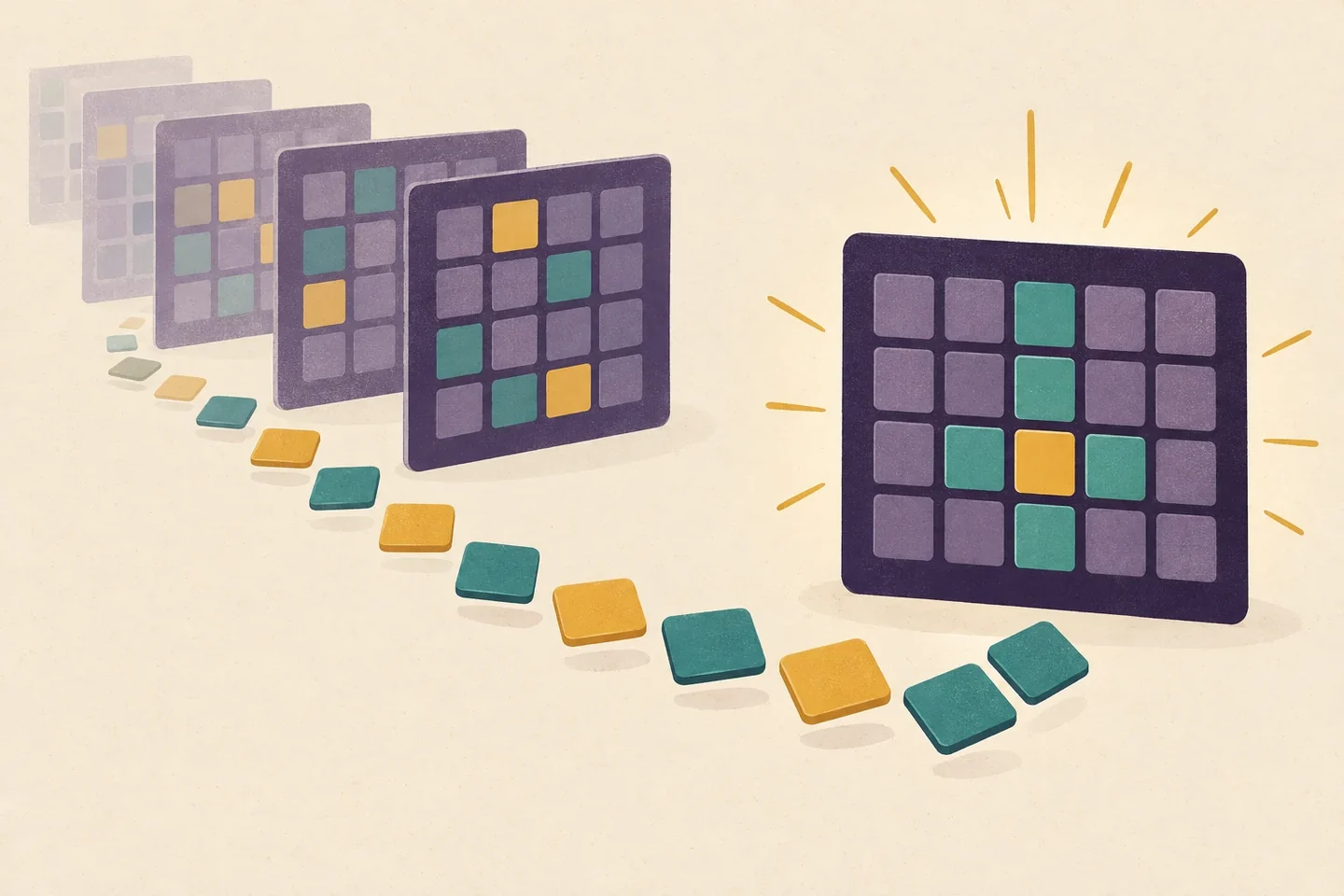
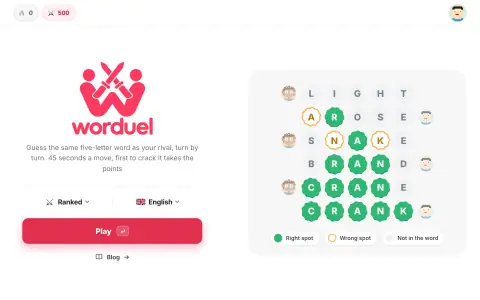
Multi-board puzzles share a guess across answers. A duel can share a board across people instead. Worduel has two players take turns guessing the same hidden five-letter word, so each move becomes a clue both rivals can use. The challenge is reading the common history before the other player does, rather than keeping several target histories separate
A different kind of shared clue
-
Worduel Top Pick
A Wordle duel: you and a rival take turns on one shared board, 45 seconds a move, in ranked games or a friend room
-
Sedecordle
Sixteen boards and 21 guesses, with a daily puzzle, unlimited free ones and modes such as Sedec-order and Variations
-
Dordle
Two Wordle boards at once: every guess counts on both words, with a new Dordle each day and as many extra games as you like
-
Duotrigordle
Thirty-two boards and 37 guesses, with a new game every day, a practice mode, daily variants and a Perfect Challenge
-
Quordle
Four five-letter words at once with nine tries for all four, a new puzzle every day on the Merriam-Webster website
-
Octordle
Eight Wordle boards at once, with a new puzzle every day on the Merriam-Webster website
Worduel is one of our games. Its turn-taking offers a useful contrast: multi-board games multiply the targets behind one guess, while a duel puts two players on one target and makes the clue history public between them
A steadier way to read a crowded round
The useful skill is not typing faster. It is deciding where each clue belongs and what a guess can accomplish across the boards still in play. A few habits make that task more manageable without relying on one fixed opening word
A useful decision loop
Separate the evidence
Keep a separate note for each board’s green positions and yellow letters, and do not transfer a gray letter from one target to another
Look for shared information
Choose an exploratory guess for the letters it can test across several unresolved boards, not just for how promising it looks on one grid
Compare the payoff
When one board has a strong candidate, check whether guessing it also tests useful letters elsewhere before spending a turn on confirmation alone
Reallocate attention
As boards are solved, shift attention to the targets still open; solved boards no longer need the same candidate-by-candidate review
That loop scales from Dordle to Duotrigordle, but the feel changes with the interface and the guess budget. A compact layout suits players who like watching a few clue patterns diverge; a sequential mode suits those who prefer one visible target at a time; a larger board field makes coordinating evidence the central puzzle. The cleverness is in the shared move: one word, many answers, and a fresh set of consequences on every board
The Multi-board category brings these related designs together, from two simultaneous targets to thirty-two