Worduel: Shared Clues, Timed Turns
Worduel turns a familiar five-letter puzzle into a timed duel where both players share every clue. Learn how its rating-based matches, friend rooms and unlimited solo mode work

Your rival’s guess lands on your board, too. In Worduel, every turn gives both players fresh evidence about the same five-letter answer, so the puzzle is as much about reading the handoff as finding the word
The whole board belongs to both players
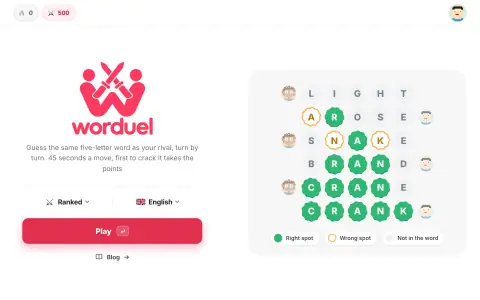
Worduel replaces the private rows of a solo Wordle-style puzzle with one board that both players use. Turns alternate, and each move is a five-letter guess at the same hidden answer. The first player to solve it wins. You have 45 seconds to enter a guess; if the clock expires, your turn is skipped, and letting four turns expire loses the duel
The colors give both sides the same basic evidence: green marks a letter in the correct position, yellow means the letter is in the answer but belongs elsewhere, and gray means there is no unused copy of that letter to match. For a simple example, imagine the answer is CRANE and the first guess is SLATE. A and E turn green, while S, L and T are gray. Both players can now hold the pattern A _ E and set those three unmatched letters aside
That shared evidence is the duel’s central twist. A guess that helps you can help your rival just as much, and their row is yours to read before your next move. A useful turn can narrow the answer, but it also gives the other player information; an immediate answer attempt may end the match, while a clue-testing guess keeps the contest going
Worduel Top Pick
A Wordle duel: you and a rival take turns on one shared board, 45 seconds a move, in ranked games or a friend room
Worduel puts the familiar five-letter deduction puzzle on a board both players can see
- Rating-based duels, friend rooms and solo play
- Six guesses per solo word
- Thirteen word languages
The appeal is in that double edge: every row is a clue for you and a gift to the other side. There is no need to wait for a separate opponent board or compare two private results; the same answer and the same history shape both players’ next choices

Choose a mode for the kind of match you want
The rating-based duel is for a quick match against an opponent selected near your rating. Everyone starts at 500. A friend room is the direct option for playing someone you invite: open a room with a four-letter code or a link, take turns on the shared board, and keep the series score. Friend matches do not change your rating
Worduel modes at a glance
| Mode | Round shape | What to expect |
|---|---|---|
| Rating-based duel | Take turns against an opponent near your rating | Starting rating is 500 |
| Friend room | Play a shared-board series with someone you invite | Join by four-letter code or link; series score is kept |
| Solo | Solve each hidden word alone | Six guesses per word; the next word appears after a win |
Friend rooms work best when the invitation is ready before the first move. Share the code or link with the other player, then use the board to follow whose turn comes next. There is no in-game chat, so agree on how to pass the invitation beforehand
Solo keeps the word puzzle but removes the rival and the turn clock. You get six guesses for each word, and solving it brings up another immediately. There is no daily limit, so the mode works for a single practice word or a longer run of puzzles
The modes change the social shape of play, not the basic act of deduction: each word is still five letters, and the board still rewards attention to every clue. The distinction is whether another player shares that evidence in real time, someone you invited is keeping a series score, or the only pressure comes from solving within six guesses
Count repeated letters, not just colored tiles
Repeated letters need a little more care than single ones. The answer can only match as many copies of a letter as it contains. If a guess uses that letter again after its available copy has already matched, the extra tile can be gray. That gray feedback means there is no unused copy left for that tile; it does not automatically mean the letter is absent from the answer
For a worked example, keep CRANE as the answer and guess EAGER. The first E is yellow because the answer has an E in another position. The second E is gray because that one E has already been accounted for. A is yellow, R is yellow, and G is gray. Read the two E tiles together: the answer contains an E, but the guess has not found a second one
The practical fix is to count confirmed copies as well as positions. Record which letters are fixed by green tiles, which confirmed letters still need a slot, and whether a gray duplicate limits the number of copies. That small count stops a repeated-letter row from making a sound clue look contradictory
Plan the move while the clock is running
Forty-five seconds rewards a compact decision process rather than a fresh start on every turn. While the other player is guessing, keep the current pattern in mind. When the board updates, focus on what that row adds or rules out, then choose a word that fits all confirmed clues
A quick turn routine
Update the board
Read the newest row alongside the earlier clues
Sort the evidence
Separate fixed positions from letters that still need a place
Count copies
Check the count when a guess repeats a letter
Make the move
Choose a fitting word that either tests an open possibility or attempts the answer
There is a real choice between testing possibilities and going straight for a likely answer. A probe is useful when its result could change the next deduction, but the rival sees it too. When the clues leave a strong candidate, a direct solve can be more valuable than gathering another row; when several answers remain, use a valid guess that helps separate them
Worduel suits players who enjoy deduction with a live opponent in the loop, especially when reading someone else’s clues is part of the fun. A friend room makes the shared puzzle a small ongoing contest, while solo is a quieter way to work through repeated five-letter words without a daily cutoff
Worduel is free, has no ads and does not require an account. It plays in a browser and has apps for iPhone and Android, with word puzzles in thirteen languages. Worduel is one of our games. For a different multiplayer twist, Transwordle changes the hidden word after every miss and recolors earlier guesses against the new target. Transwordle is one of our games. Worduel sits naturally among With friends formats because both players work from the same clues, and its solo mode also belongs with Unlimited play because a new word is ready after each win